




Contents
Starting January 21, 2026, the TOEFL iBT will undergo one of its biggest updates in years. ETS (the organization behind the TOEFL) is redesigning the test to make it shorter, adaptive, and more relevant to real-world academic and daily situations.
If you’re planning to take the TOEFL in 2026 or later, understanding these updates is essential. Let’s break down everything you need to know about the new TOEFL format, from section structure to timing and scoring, so you can prepare smarter and stay ahead of the changes.
Here is a description of the major changes:
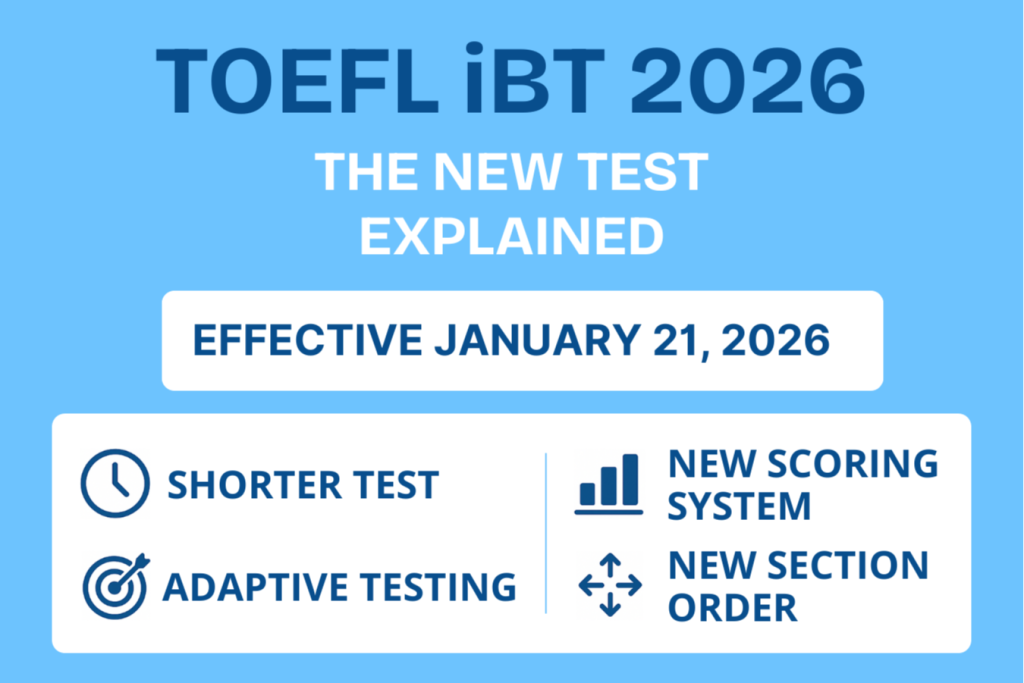
<Key Changes to the New TOEFL Format>
- Adaptive Testing
The Reading and Listening sections will be in a multistage adaptive format. This means that the difficulty of the questions in the next stage of each section will be changed based on a test-taker’s performance in the previous stage. - Total Test Time
The total test time will be reduced to under 2 hours. - Content Focus
Content will be updated to include a wider mix of academic topics and more relevant, modern, and fair content, including real-life campus and daily situations. - New Scoring Scale
In addition to the traditional 0–120 score, a new 1–6 banded score (in half points – for example, 3.0 and 3.5) will be introduced for each section, which is similar to the Common European Framework of Reference for Languages (CEFR). The total score of the new TOEFL iBT is the average of the banded scores from each section of the test. - Order of Sections
On the new version of the test, the order of sections will be Reading, Listening, Writing, and then Speaking.
The new TOEFL iBT will continue to have the MyBest score on the score report for a test. As a reminder, MyBest score is a combination of the best scores that a test-taker has gotten on each section of tests that have been taken in the last two years.
1. Reading Section: Structure & New Task Types
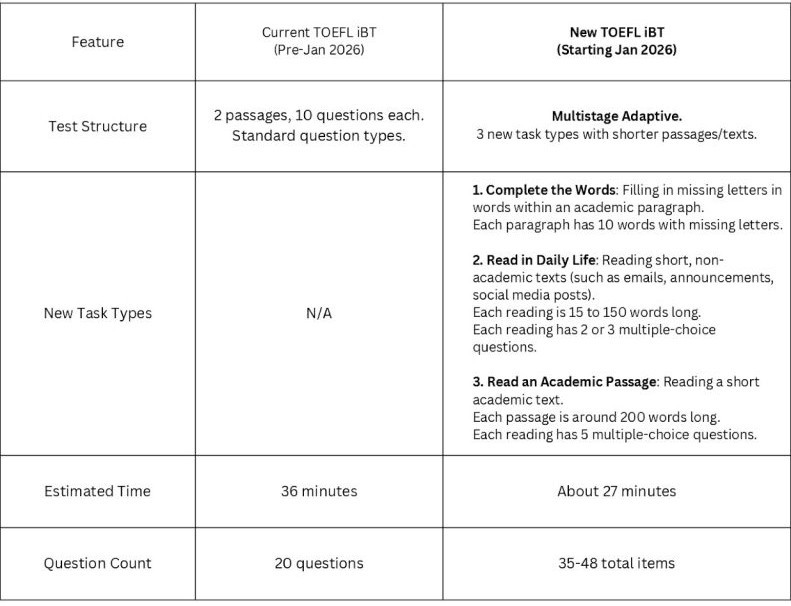
Previously, the Reading section had two long passages (about 700 words each) and 10 standard questions per passage. Now, ETS is introducing a multistage adaptive format — meaning the difficulty level of questions will adjust based on how you perform as you go.
What’s even more interesting is the introduction of three new task types designed to reflect real-life and academic reading experiences:
1. Complete the Words – You will fill in missing letters in academic paragraphs.
Each paragraph includes 10 incomplete words.
2. Read in Daily Life – You will read short, practical texts like emails, announcements, or social media posts (15–150 words each).
Each text has 2–3 multiple-choice questions.
3. Read an Academic Passage – You will read a short academic text (around 200 words).
Each passage has 5 multiple-choice questions.
These changes make the reading tasks shorter, more focused, and diverse, testing your ability to understand both academic and everyday English.
⏱ Estimated time: About 27 minutes (reduced from 36 minutes)
❓ Total items: 35–48 (instead of 20 questions)
2. Listening Section: Structure & New Task Types
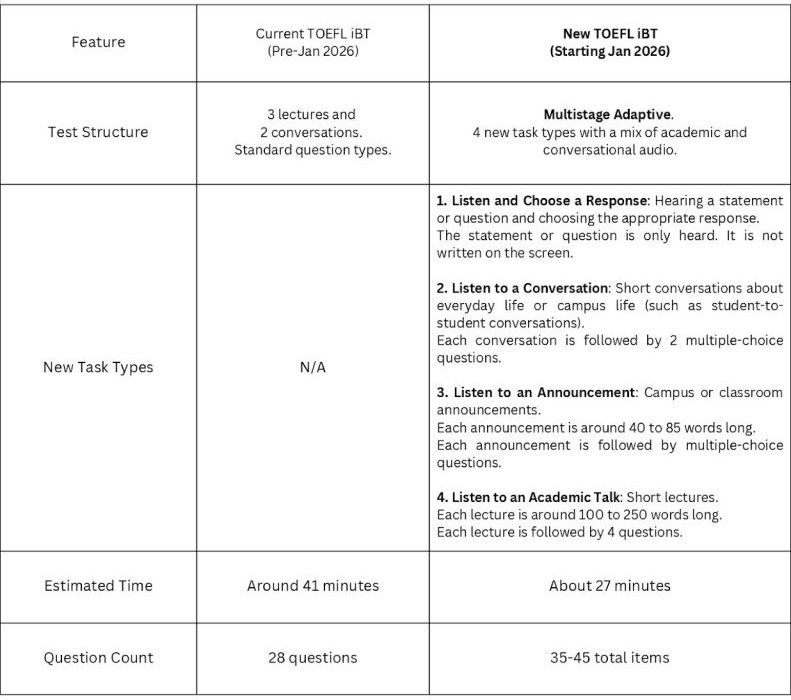
The Listening section will also move to a multistage adaptive format, meaning the difficulty of questions will adapt to each test taker’s performance. In the past, the Listening section had 3 lectures and 2 conversations, all following a fixed format.
Starting January 2026, the section becomes more dynamic with four new task types combining academic and conversational listening:
1. Listen and Choose a Response – You will hear a short statement or question and select the appropriate response.
The text is not shown on screen — you will only be able to hear the statement or question..
2. Listen to a Conversation – Short everyday or campus-life conversations (e.g., student-to-student).
Each conversation is followed by 2 multiple-choice questions.
3. Listen to an Announcement – Campus or classroom announcements (40–85 words).
Each one is followed by several multiple-choice questions.
4. Listen to an Academic Talk – Short lectures (100–250 words).
Each lecture is followed by 4 questions.
These updates make the Listening section more interactive and realistic, similar to what you’d encounter in real campus settings.
⏱ Estimated time: About 27 minutes (reduced from 41 minutes)
❓ Total items: 35–45
3. Writing Section: Structure & New Task Types
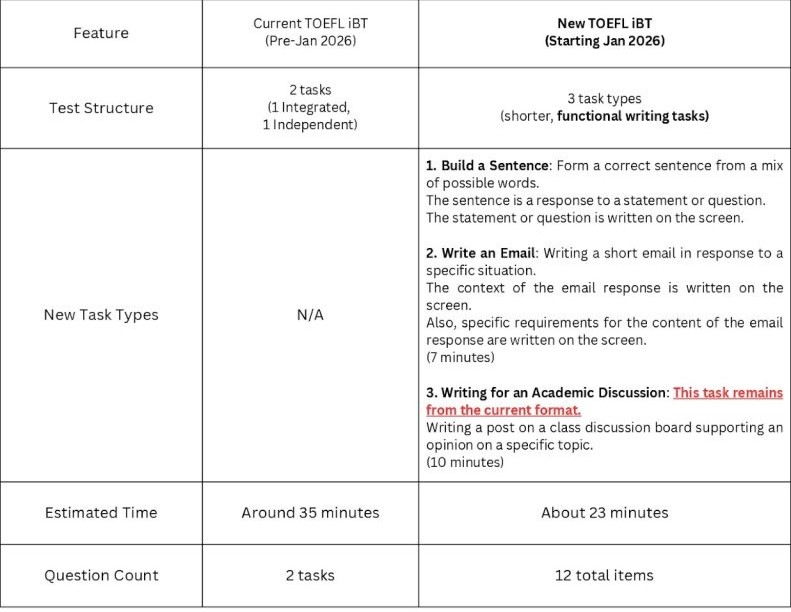
Previously, the Writing section consisted of 2 tasks (1 Integrated and 1 Independent). Starting in January 2026, the section will feature three task types focusing on shorter, functional writing. The total time will be about 23 minutes (reduced from around 35 minutes). The new format will assess 12 total items.
Here are the new task types:
1. Build a Sentence: You will form a correct sentence from a mix of possible words. The sentence is a response to a statement or question that is written on the screen.
2. Write an Email: You will write a short email in response to a specific situation. The context and specific requirements for the content of the email response are written on the screen. The time limit to complete the task is 7 minutes.
3. Writing for an Academic Discussion: This task remains from the current format. You will write a post on a class discussion board supporting an opinion on a specific topic. The time limit to complete the task is 10 minutes.
These updates emphasize both academic and practical writing skills, making the tasks shorter, more focused, and diverse.
⏱ Estimated time: About 23 minutes (reduced from around 35 minutes)
❓ Total items: 12 total items (instead of 2 tasks)
4. Speaking Section: Structure & New Task Types
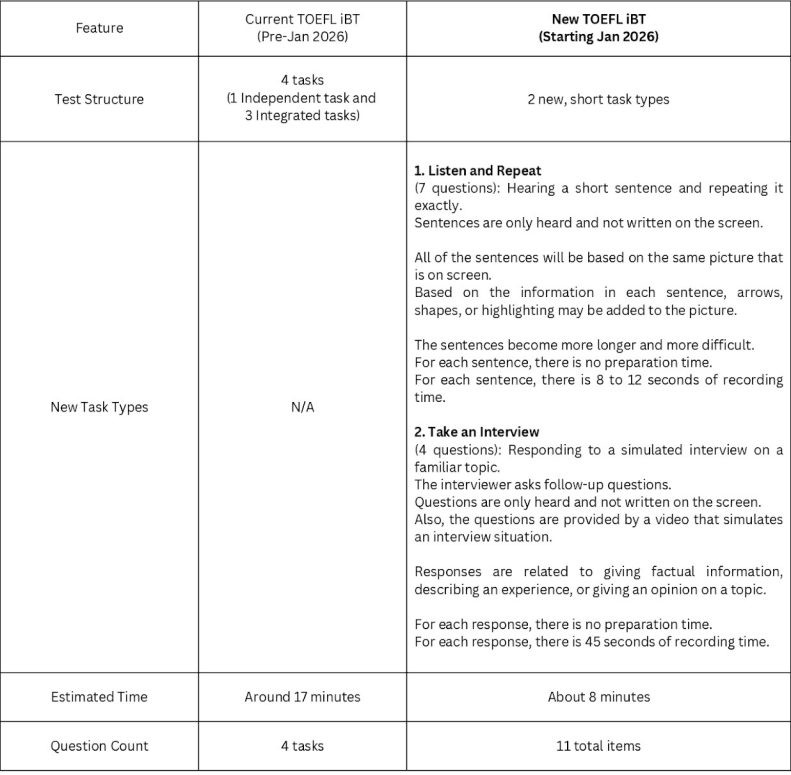
The Speaking section previously had 4 tasks (1 Independent and 3 Integrated tasks). Starting in January 2026, the section will be restructured with 2 new, short task types. The total time will be about 8 minutes (reduced from around 17 minutes). The new format will assess 11 total items.
The two new task types are:
1. Listen and Repeat (7 questions): You will hear a short sentence and must repeat it exactly. Sentences are only heard and not written on the screen. All sentences will be based on the same picture that is on screen. Based on the information in each sentence, arrows, shapes, or highlighting may be added to the picture. The sentences become longer and more difficult. There is no preparation time for each sentence, and you have 8 to 12 seconds of recording time.
2. Take an Interview (4 questions): You will respond to a simulated interview on a familiar topic. The interviewer asks follow-up questions. Questions are only heard and not written on the screen, and are provided by a video that simulates an interview situation. Responses are related to giving factual information, describing an experience, or giving an opinion on a topic. There is no preparation time for each response, and you have 45 seconds of recording time.
This revised section focuses on spontaneous response and real-time verbal communication skills.
⏱ Estimated time: About 8 minutes (reduced from around 17 minutes)
❓ Total items: 11 total items (instead of 4 tasks)
<Why the 2026 Changes Matter & How to Prepare for the New TOEFL>
The new TOEFL iBT, starting in January 2026, is changing to enhance efficiency and reinforce practical English skills. With a shorter test time, the introduction of the adaptive format, and new real-world question types, a fresh, targeted study strategy is essential.
* Shorter Test Time: Reduced from three hours to under two hours.
* Adaptive Testing: The Reading and Listening sections will use a multistage adaptive format.
* New Scoring Scale: A new 1-6 banded score (similar to CEFR) will be introduced alongside the traditional 0-120 score.
* Enhanced Practicality: Shorter, functional tasks related to real-life campus and daily situations are being added across all four sections.
Have Questions About the New TOEFL? Ask Anytime!
Due to these major updates, trying to analyze and prepare for the new test alone can be inefficient and overwhelming.
We, the experts at Mentor Language Institute (MLI), are a specialized institution for the new TOEFL iBT, accurately responding to changes based on official ETS information. We offer everything you need for success: in-depth analysis of new task types, strategic test-taking skills, and focused practice for the reduced test time.
If you have any questions, please feel free to contact us at info@mliesl.edu!

Kyle Hanano has been an English teacher since 2005. He has experience teaching students of all ages and skill levels. However, he has the most teaching experience in test preparation, especially in regards to the TOEFL examination. He has been a part of Mentor Language Institute since 2008. Prior to that, he was an assistant language teacher in Japan with the JET Programme for three years. He holds a B.A. in English Literature and a B.A. in Japanese Language and Culture from the University of California at Los Angeles, and he graduated in 2005.